


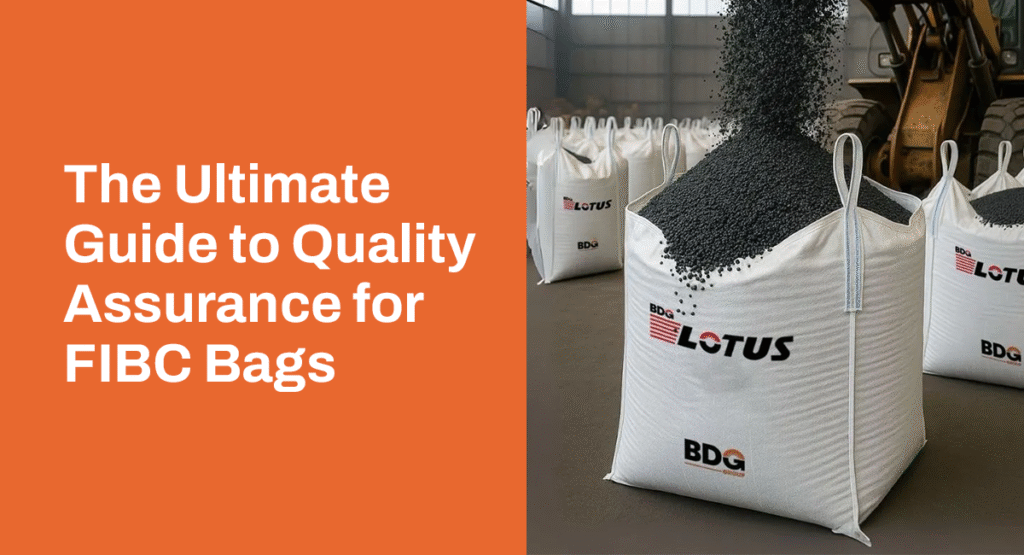
Flexible Intermediate Bulk Containers (FIBC bags) are a trusted packaging solution for transporting and storing bulk materials such as grains, powders, minerals, chemicals, and construction aggregates. While their capacity and versatility are unmatched, quality assurance is the most crucial factor in ensuring safety, durability, and compliance with industry standards.
In this ultimate guide, we’ll walk you through the importance, process, and standards involved in ensuring the highest quality for FIBC bags.
Why Quality Assurance Matters for FIBC Bags
The primary role of quality assurance in FIBC bag production is to ensure that each bag performs reliably under real-world conditions. Poor-quality bags can lead to:
- Product loss and contamination
- Safety hazards during lifting and transport
- Failure to meet regulatory requirements
- Damage to brand reputation
A strong quality assurance process guarantees product safety, consistency, and compliance with customer and industry expectations.
Key Quality Parameters for FIBC Bags
1. Material Strength
- Polypropylene Fabric Quality: Must meet required tensile strength and weight specifications.
- UV Resistance: Protects bags from degradation due to prolonged sun exposure.
2. Load Capacity & Safety Factor
- FIBC bags are tested for their Safe Working Load (SWL) — commonly ranging from 500 kg to 2000 kg.
- Safety Factor Ratio (SFR): Standard FIBC bags are tested with a 5:1 ratio, meaning they can hold five times their rated SWL without breaking.
3. Stitching and Seams
- Reinforced stitching is essential for load-bearing strength.
- All seams must be inspected to ensure no fraying, skipped stitches, or weak points.
4. Dimensional Accuracy
- Bags must match the specified length, width, and height for consistent stacking and transport efficiency.
5. Coating & Lamination
- For moisture-sensitive products, the coating or lamination must be tested for water and dust resistance.
6. Lift Loops and Handling Features
- Loops must be strong enough to withstand repeated lifting without tearing.
- Compatibility with forklifts, cranes, or hoists is tested.
Quality Assurance Process for FIBC Bags
Step 1: Raw Material Inspection
- Inspect incoming polypropylene granules or yarn for quality compliance.
- Verify UV stabilizers, additives, and color consistency.
Step 2: Fabric Weaving Inspection
- Check fabric strength, weaving pattern, and uniformity.
- Test for GSM (grams per square meter) accuracy.
Step 3: Printing & Branding Quality
- Ensure printing clarity, color accuracy, and durability under handling.
Step 4: Assembly & Stitching Quality Check
- Visual inspection for alignment and accuracy of seams, loops, and spouts.
Step 5: Performance Testing
- Top Lift Test: Ensures the bag can handle more than its rated load.
- Drop Test: Simulates accidental drops to test impact resistance.
- Stacking Test: Tests stability under vertical load for extended periods.
- Cyclic Top Lift Test: Checks durability under repeated lifting cycles.
Step 6: Final Inspection
- Verify all measurements, weight, and packaging before dispatch.
International Standards for FIBC Bag Quality
FIBC bags must comply with recognized global standards, such as:
- ISO 21898: Packaging – Transport packaging for bulk solids.
- UN Recommendations on the Transport of Dangerous Goods (for hazardous material bags).
- BIS Standards (Bureau of Indian Standards) for domestic compliance.
Best Practices for Maintaining FIBC Bag Quality
- Choose reputed suppliers with certified manufacturing units.
- Request third-party quality test reports before bulk purchase.
- Train staff in safe handling and storage to prevent damage.
- Store bags away from direct sunlight and in dry conditions.
Conclusion
Quality assurance for FIBC bags is not just about passing a checklist — it’s about ensuring safety, reliability, and customer satisfaction. From raw material selection to final inspection, every stage plays a crucial role in delivering a product that meets the highest standards.
By working with a trusted supplier and adhering to strict testing protocols, businesses can enjoy the benefits of durable, compliant, and high-performance FIBC bags that safeguard their products and reputation.